Night shots in Scarborough

Last week there was a great moon and some clear nights - a not so common event on the east coast of the UK. Moreover the moon was relatively low at the right time. I therefore managed some shots on a couple of nights that I like.

Castle and moon
D800E 70-200 at 70mm and 5secs at f7.1

North Bay ripples and rocks
D800E 16-35 at 17mm and 241secs at f14
The shot with the moon was short as I wanted to get it with little movement and I wanted the stars as points rather than streaks.

There will be more images from these sessions on the website this week.

Skye gallery launched on website

White-tailed eagle (Haliaeetus albicilla)
Nex 7 55-210 @ 210mm 1/50 f13

I have finally finished creating and editing the images from my Skye trip. I have cut them down to 48 which summarises my trip for me and shows my vision of this stunning island.

A new image gallery has been added to the website for the Isle of Skye with fine art monochrome images of this one of the Inner Hebrides of the Scottish coast.

Go to the gallery.

The Cuillin

The mountains on Skye are called the Cuillin and they can be split into two groups. The true Cuillin are also known as the Black Cuillin to distinguish them from the Red Hills (Am Binnean Dearg) across Glen Sligachan. The Red Hills are lower and are less rocky. The highest point of the Cuillins, and of the Isle of Skye, is Sgùrr Alasdair in the Black Cuillins at 992 m (3,255 ft).


The Black Cuillin from Sligachan I
Nikon D800E 16-35 @ 35mm 1/125 f16


The Black Cuillins are mainly composed of basalt and gabbro. The former is 
usually grey to black in colour and formed from the rapid cooling of basaltic lava exposed at or very near the surface of the earth. It rapidly weathers to brown or rust-red due to oxidation of its iron-rich minerals into rustIt is from the dark colour of the gabbro that the Black Cuillin receives its name. The summits of the Cuillins are bare rock, jagged in outline and with steep cliffs and deep cut corries and gullies. There are twelve Munros on Skye, which are all Black Cuillin peaks, though Bla Bheinn is part of a group of outliers separated from the main ridge by Glen Sligachan.

The Red Hills (Am Binnean Dearg in Gaelic) are sometimes known as the Red Cuillin. They are mainly composed of granite which is paler than the gabbro  and has weathered into more rounded hills with vegetation covering their summits and long scree slopes on their flanks. Granite is a common widely occurring type of igneous rock which is granular and crystalline in texture and consists mainly of quartz, mica, and feldspar. Granites can be pink to gray in color, depending on their chemistry and mineralogy and their colour often varies in different lights and from different angles.


The Red Hills from Sligachan I
Nikon D800E 16-35 @35mm 1/50 f16

The highest point of the hills is Glamaig, which is almost conical from most aspects and is the northernmost of the Red Hills.


Glamaig III
Nex 7 18-55 @ 34mm 1/400 f4.5

The Battle of Coire Na Creiche was fought on the slopes below Bruach na Frìthe in 1601. It was the last Scottish clan battle fought on Skye, in which the Clan MacDonald of Sleat defeated the Clan MacLeod after a bitter feud.


Coire na Creiche III
Nex 7 18-55 @ 18mm 1/60 f11

In 2000 the Cuillins were put on sale for £10 million by the Laird in a scheme of land in exchange for repairs to Dunvegan castle. Following a dispute over ownership, a deal was cut for the property to be gifted in return for repairs to the clan castle


Bla Bheinn II
Nex 7 55-210 @ 195 1/250 f11
I wanted to capture the majesty of these mountains and their dominance of the landscape. I was also struck by the stark contrast between the perceived ruggedness of the Black Cuillin and the smoothness of the Red Hills. For most of the two weeks the tops of the mountains were not visible, although they were on a couple of days, most of the time they were shrouded in cloud. The interplay between the rocks, light and mist was fascinating to anyone who has time to watch and marvel at the light.

2 weeks on Skye - the return

The Cuillin from Caiplach I
Nex 7 Lensbaby Edge 80


I have just returned from two weeks on Skye on the north west coast of Scotland. There I spent a lot of time reflecting and meeting some great people. I was with the family on our annual summer holiday, which has been spent in Scotland for the last 3 years.

I visited a lot of galleries - in the first week I went to some photographic galleries and in the second week I consciously avoided them. This was for two reasons. The first was that most of the images are very similar and the second is that I realised that I wanted a different type of inspiration by studying the eye of a painter or sculptor etc rather than another photographer.

To expound upon the first reason - in the past I have visited photographic galleries, looked at other sites on the internet, studied books and magazines and come to the conclusion that a lot of landscape photography is the same, or very similar. I assume this is because the artists are all trying to sell their art to survive and clearly the market  demands Cornish Pastiches, with the added saturated colour and sunrises or sunsets. Whilst this is clearly for many it is not for me. I wish to tap into my inner soul and project this in the images I create.

The second reason was to gain new inspiration. The painter can include and exclude and thereby simplify their composition. Their 'eye' creates the image and they develop the mood by the way they portray the landscape in front of them. The use of light by some is truly remarkable.

As I have written before I usually travel having done my homework and with some preconceived ideas of what I want to achieve. This time I prepared in a different way. Having been to Skye before I knew somewhat  what to expect. I had the Ordnance Survey maps and knew where our cottage was. This was all. I did not use Google Earth or The Photographer's Ephemeris. I had not even looked up the tides.


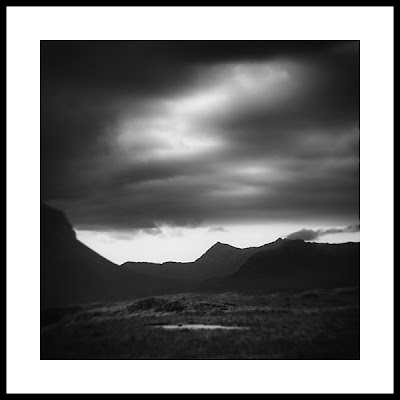
Beinn Dearg Mhor IINex 7 Lensbaby Edge 80


I had decided to be more spontaneous on this trip and therefore went with some projects in mind to drive my images, however these were very loose. I wanted to look at 'worship/religion' and perhaps tie this into history. I wanted to capture the essence of the weather which I knew was predicted to be poor, even though it was August. I wanted to try to show the contrast between the 'anger' of the mountains and the 'peace' of the coast, although living at the coast, I know that it is not always peaceful and can easily display it's own form of anger. These themes I remembered influencing me when I was last on 'The Misty Isle'. Finally I was going to have a rest and therefore I was not going to get up for one sunrise and I was on holiday with two young girls and I wanted to spend time with them and so I was not going to go out for one sunset. This was perhaps the hardest part of the holiday for me as I have been indoctrinated by the plethora of books and sites telling me that this is photographic sacrilege.

Now I have the pleasure/difficulty/disappointment of sorting and developing my visions. Now I am busy sorting and developing my visions to convey the mood/emotion felt at the time. What is fascinating to me is the transference of my mood in these images as the first and second week were very different.
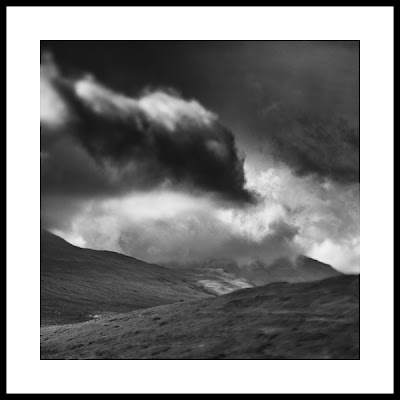

Beinn Dearg Mhor IIINex 7 Lensbaby Edge 80


I am not sure whether they will make the final 'keepers', but they do demonstrate a point to me and that is that all the images here were made in the first week and are very dark. The second week's images were less dark and I made fewer blurred images. I will expound upon mood and image making in another post.

New images on the website

Many new images have been added to the Liverpool gallery. Check it out and let me know what you think.

Return from trip to Liverpool

How do we fit it all in? Everyone's life is so busy.

We have just returned from a weekend photographing in Liverpool. Having been there a couple of months ago for work and seeing plenty of potential shots we spent a weekend capturing some of those shots.
The weather was decidedly variable with sun, cloud, showers and heavy rain. I love inclement weather as it allows one to take more original and less postcard like shots. The other advantage is that few photographers are out.
Below are some of my favourite of the images taken of the churches in Liverpool. All were taken using a tripod.

Our Lady and St Nicholas V
Nex 7 55-200

Our Lady and St Nicholas I
Nex 7 55-200 13 stop ND

Liverpool cathedral IV
Nex 7 18-55

The Metropolian Cathedral I
Nex 7 18-55 10 stop ND


Check out more images in the Liverpool gallery.

A day out at The Yorkshire Air Museum with a Lensbaby

Handley-Page Victor I


Hawker Siddeley Nimrod I


A day out with the family at the Yorkshire Air Museum at Elvington give me a chance to venture out with a Sony Nex 5 and a Lensbaby Composer with a plastic lens.

English Electric Canberra

De Havilland Vampire

Lockheed Canadair Silver Star


Hawker Siddeley Nimrod II


Corrugated shed


Common darter (Sympetrum striolata) I

New images on the website

Moored in the Bay
D800E 70-200f2.8 70mm 2.5 secs f9.0


I have added some new images taken this month into the Filey gallery. I have also added a new gallery with 3 images taken in Hornsea, which is a small town on the East Yorkshire coast.


Hornsea groyne I
D800E 70-200f2.8 70mm 90 secs f16

Less is more - carry less gear

Defiance

I love minimalism and try to apply the philosophy to most of my life, with varying success. It is difficult when most others seem to want more.

The application of the philosophy to photography is interesting. One can apply it to the gear one uses and there are successful photographers that use one camera and one lens. Of course looking back into the archives many of the greats did not have large numbers of cameras and lenses.

So ask yourself what do you actually need? A camera and a lens, possibly a filter such as a polarizer – an effect that cannot really be created digitally – a tripod possibly and a bag. Everything else is luxury.


Gull and lighthouse

What is the benefit of this approach? Travelling light allows you access to places you find difficult to get to with a large bag on your back. If you do street photography you do not stand out as a photographer. Perhaps the most important is that your back remains intact. It seems that one of the burdens of the wildlife/bird photographer is the carrying of large lenses and tripods with the impact this has on their lower backs.

I used to carry a large tripod, two camera bodies, at least three or four lenses and teleconvertors, lots of filters, an angle viewer, a flash or two and lots of gadgets. Now I carry a maximum of two lenses, possibly a Lensbaby and a couple of filters that I have learned help creating my vision. I also carry a notebook and pen to make notes on my why I have taken that particular shot and what my vision at the time was. I will cover this more in the next post.

So what is the attraction of minimalism as applied to gear? Carry less and concentrate more on images. Walk more, look more, see more. Become more au fait with your gear and learn to ‘see’ with each lens. You do not have to carry the same lens all the time.

Remember the two most important items of equipment for your photography are your eyes and your creative mind.


7 sticks
All images taken from mainprize.net.

Always carry a camera

Once a photographer, always a photographer. Can you switch it on and off?

I don't think so and therefore I always have a camera with me. Here is a case in point. I was driving home the other night and looking about me as I always do when I realised the clouds were clearing. By the time I got near There was blue sky and fast moving clouds - my favourite weather - and the rain had stopped. What's more the clouds were moving across the sky in such a way that I knew one of my favourite fields would potentially yield a great minimalist long exposure. With the gear in the car I could stop and get my shot.

I was pleased with the result and as the clouds were moving so fast got a couple of very different images with and without the sun on the field. If I had not got my camera I would have missed the chance or had to get home and then go out again.

Here is one of them:

Folkton field IV
Nikon D800E 16-35 25secs at f16
Processed in Adobe Lightroom Photoshop CS5 and Nik Silver Efex 2